| EVAMCARE CTNI/MYO/CK-MB Rapid Test Panel Specification |
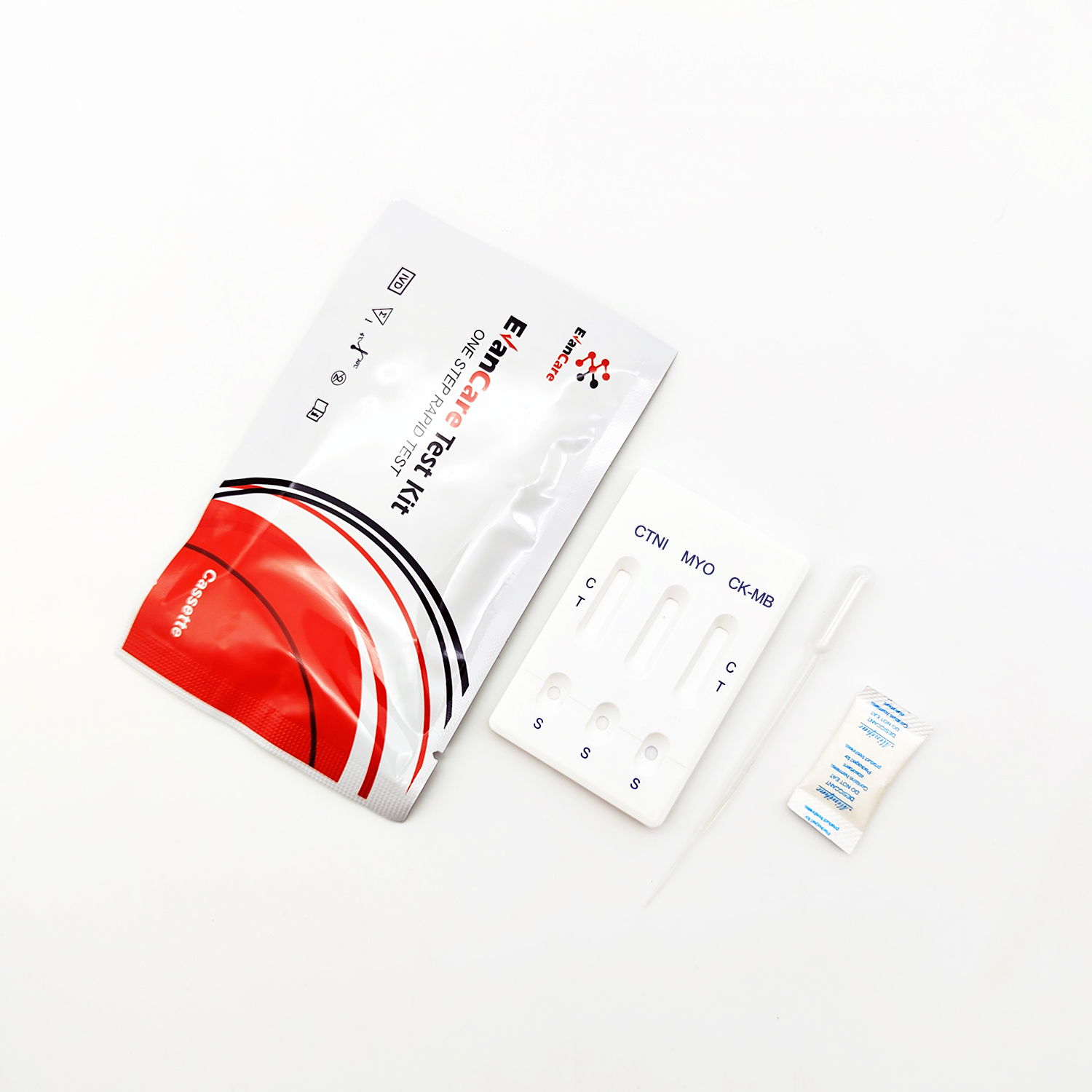
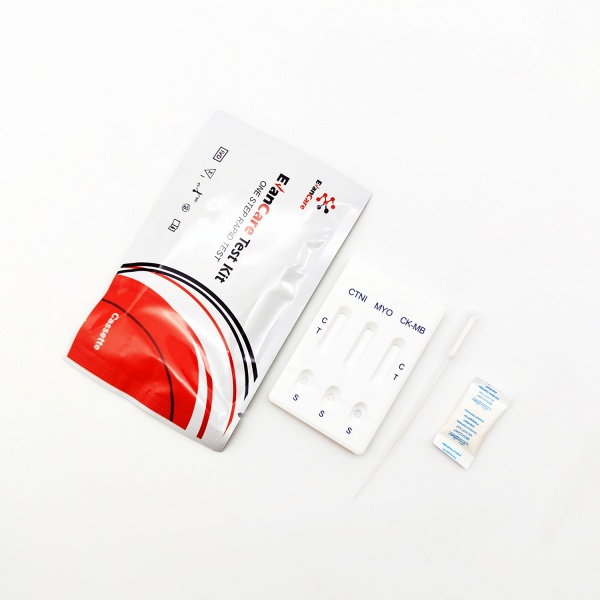
| Catalog No. | EC-CTNI/MYO/CK-MB1001 | Format | Cassette |
| Specimen | Whole blood/Serum/Plasma | Test/Box | 25/40 |
| Reading Time | 15 minutes | Shelf Life | 3 Years |
| Storage Temperature | 4-30°C | Specificity | >99.9% |
| Sensitivity | >99.9% | Composition | Individually packed test device, Package insert, Dropper, Buffer
|
| Accuracy | >99.9% | Feature 1 | High Accuracy |
| Feature 2 | High Sensitivity | Feature 3 | Clear Results |
| Feature 4 | Easy To Read | Feature 5 | Easy To Use |
| Feature 6 | OEM/ODM Available | Feature 7 | Quality Guarantee |
EVAMCARE CTNI/MYO/CK-MB Rapid Test Test Proceduce
Intended Use
This reagent is used for qualitative detection of troponin I, myoglobin, creatine kinase isozyme in human serum, plasma and whole blood in vitro. Myo can rise as soon as 2 hours after the onset of chest pain, which is a good early indicator for the diagnosis of acute myocardial infarction (AMI); when myocardial injury occurs, myocardial troponin complex is released into the blood, 4-6 hours later, began to rise in the blood, elevated troponin I can remain in the blood for 6-10 days, providing a longer detection period. cTnI is a highly specific indicator for diagnosing AMI. Although CK-MB is not as early as Myo and less sensitive than cTnI, it has certain value for the diagnosis of early infarction after AMI. It is clinically proven that any single test result may be misdiagnosed and missed, and joint testing is more helpful for early and accurate diagnosis of acute myocardial infarction.
Test Principle According to the gold immunochromatographic test principle, the nitrocellulose membrane was coated with Myo/CK-MB/cTnI monoclonal antibody 1 and goat anti-mouse IgG antibody, the colloidal gold conjugate pad was labeled with Myo/CK-MB/cTnI monoclonal antibody 2. When Myo/CK-MB/cTnI was contained in the sample, it binds with the colloidal gold conjugate pad labeled Myo/CK-MB/cTnI monoclonal antibody 2 to form a complex, moves forward under the chromatography, then combines with the coated antibody in the test line to form complex to condenses into a colored line (Test line, T), indicating a positive result. When the sample does not contain Myo/CK-MB/cTnI, complex cannot be formed in the T line, and no colored line appears in the T line, indicating negative result. No matter whether the samples contain Myo/CK-MB/cTnI or not, a colored line will always appear in the control region(C) if the test has been performed properly.
Main Components
Sample pad, colloidal gold conjugate pad, nitrocellulose membrane, absorbent paper and PVC board. Colloidal gold conjugate pad labeled with Myo/CK-MB/cTnI monoclonal antibody 2, nitrocellulose membrane coated with Myo/CK-MB/cTnI monoclonal antibody 1 respectively and goat anti-mouse IgG antibody. Sample diluent: Phosphate containing buffer. Disposable plastic straws (optional). Description: Different components of different batches cannot be used at the same time to avoid erroneous results.
Material Needed But Not Provided
1. Timer
2. Personal protective equipment, such as protective gloves, medical mask, goggles and lab coat.
3. Appropriate biohazard waste container and disinfectants.
Storage and Expiry Store in a dry environment at 4-30°C, avoid hot and sunshine, valid for 36 months. DO NOT FREEZE. Some protective measures should be taken in hot summer and cold winter to avoid high temperature or freeze-thaw.
Sample Requirement 1. The reagent can be used for the serum, plasma and whole blood samples. 2. Serum, plasma and whole blood samples must be collected in a clean and dry container. EDTA, sodium citrate, heparin can be used as the anticoagulants. Recommend to detect immediately after collecting blood. If blood coagulation occurs, serum sample is suggested to use. 3. Serum and plasma samples may be stored at 2-8°C for 1 week prior to assay, and at -20°C for 2 years. Frozen and refrigerated samples should be equilibrated to room temperature before detection and thoroughly mixed. Repeat freeze and thaw for no more than 3 times. Samples that exhibiting visible precipitates, stink or muddy should not be used. 4. Whole blood samples with anticoagulants may be stored at 2-8°C for 24 hours, and should be used immediately without anticoagulants. DO NOT FREEZE. Mix the sample well by gentle inversion of the tube immediately before testing.
Test Procedure
Instruction for use must be read entirely before taking the test. Allow the reagent to equilibrate to room temperature for 30 minutes (10-30°C) prior to testing. Do not open the inner packaging until ready, it must be used in one hour if opened (Humidity≤60%, Temp: 10-30°C). Please use immediately when the humidity exceed to 60%.
1. Remove the panel from the sealed pouch, and put it onto the desk with the sample well up.
2. Add 3 drops (80-100μL) of serum, plasma or whole blood vertically into the sample well of panel. If the blood is thick, add about 1 drop of (40μL-50μL) sample diluent into the sample well of panel. Serum or plasma samples do not require sample diluent. Note: Serum or plasma samples do not require sample diluent.
3. Observe the test results immediately within 15-20 minutes, the result is invalid over 20 minutes.
Note: The diagram is for reference only. See the real object for details. The appearance and color of reagent components may be different from the actual product, which has no effect on normal use.
Result Explanation
Positive: Two distinct colored lines appear. One line should be in the control line region (C) and another line should be in the test line region (T).
Negative: One colored line appears in the control line region (C). No line appears in the test line region (T).
Invalid: The result is invalid if no colored line appears in the control line region (C), even if a line appears in the test line region (T). You should repeat the test with a new test reagent.